

Slovakia has a well-developed research and innovation ecosystem combining universities, the Slovak Academy of Sciences, public research organisations, private R&D centres and innovative companies. The country has a strong industrial base, particularly in automotive and engineering, while knowledge-intensive sectors such as ICT, electronics, life sciences, advanced materials, energy and space technologies are also developing.
Slovakia’s position in research and innovation is supported by its location in the centre of Europe, a strong technical and engineering tradition, an established industrial base and a growing network of cooperation between academia and industry. The Slovak Government identifies research, development and innovation as important drivers of the country’s transition towards a knowledge-based economy. The National Strategy for Research, Development and Innovation 2030 and the updated priorities of the Slovak Research and Innovation Strategy for Smart Specialisation (SK RIS3 2021+) provide the strategic framework for national research and innovation policy.
Slovakia has traditionally been strong in automotive and mechanical engineering, supported by a broad supplier network, technical universities and R&D activities connected with industrial production. The country is the world leader in car production per capita and hosts major international automotive manufacturers, including Volkswagen, Stellantis, Kia, Jaguar Land Rover and Volvo. The sector is undergoing a major transformation driven by electromobility, battery technologies, automation, digitalisation, autonomous driving and new materials.
Other important areas of research and innovation include:
- Information and communication technologies (ICT), artificial intelligence and cybersecurity
- Electronics and electrical engineering
- Advanced materials and nanotechnology
- Pharmaceuticals, biotechnology and life sciences
- Energy technologies and hydrogen
- Automation, robotics and smart manufacturing
- Intelligent transport systems and smart mobility
- Environmental technologies and the circular economy
- Agricultural and food technologies
- Aviation and space technologies
Slovakia has emerged as a significant location for advanced research and practical applications, making it an attractive destination for foreign investors. Notably, it has one of the highest shares of high-tech exports in the EU, and it is the leading producer of cars per capita globally. Successful Slovak companies, such as ARDACO, SOITRON, ESET, Anasoft (ICT security sector), c2i (carbon-fibre components), GA Drilling (plasma drilling technology), MulitplexDX (personalised molecular diagnostics – including cancer and Covid-19), SanaClis (Clinical Trial Services), Glycanostics (non-invasive cancer diagnostics), Axon Neuroscience (Preventing Alzheimer’s disease), Powerful Medical (AI diagnostics of cardiovascular diseases), NG Aviation (airport digitalisation), Sygic(navigation systems), Microstep-MIS (weather and environment monitoring and information systems) exemplify the country’s innovative potential. A strong focus on the automotive industry is also reflected in the development of hydrogen-powered concept car (cooperation of Technical University of Košice with Matador group) and innovative electric battery solutions (InoBat). Innovations leading to sustainable and ecological solutions could be found e.g. with Sensoneo (smart waste management) or in energy-efficient tech solutions (Tachyum - chips). In the field of AI research, centres like KInIT have managed to gain international recognition. Another Slovakia's dynamically expanding segment is Space Industry, actively involving more than 45 companies. Although more than half of them are focused on the upstream segment, the majority of the space-related revenue is concentrated in software applications using Earth observation or positioning data. Among the most successful companies in this area are: CTRL (electromechanical components), Spacemanic (small satellite mission integrator, Spacemanic’s engineers were involved in the project of the first Slovak satellite skCUBE which was fully developed in house), Myspectral (custom spectrometers, field spectrophotometers and spectrometric cameras), Needronix (development of smart sun sensors, as well as telemetry, tracking and command systems and ground segments), Borospace (development of suborbital rocket Ardea with hybrid propulsion, working on sustainable hybrid wax fuel, and a mobile rocket motor test bed/rocket launcher), and Masam (metallic component production for global aviation and space companies).
The Slovak research environment can be characterised by describing its research‑related legislation, by identifying Slovak research institutions where you could find a job or collaboration, and by identifying funding opportunities (on national, bilateral, multilateral level) for your research in Slovakia.
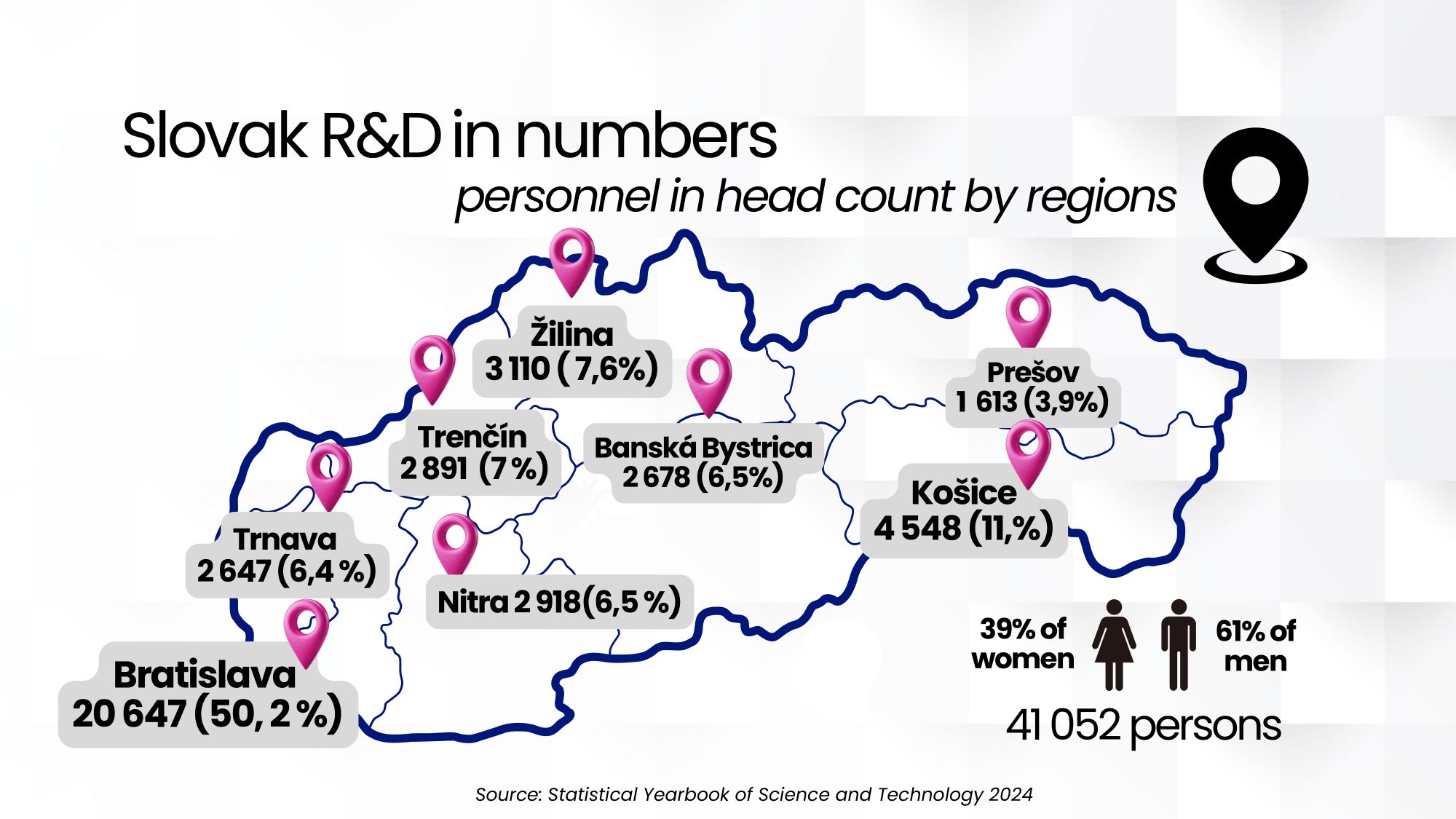
Bratislava Region
Bratislava is Slovakia's main centre of research, higher education and innovation. It hosts major universities, Slovak Academy of Sciences institutes, public research organisations and numerous private R&D and technology companies. This region is considered among the most innovative in the new EU member states. In addition to research organisations and universities, numerous innovative companies in Bratislava are driving cutting-edge research in fields such as cybersecurity (ESET), audience interaction (Slido), AI (KInIT), navigation systems (SYGIC), biometrics (INNOVATRICS), photonics (Photoneo), game development industry (PIXEL Federation, Studio 727)and more. But research excellence and strong innovation potential can also be found elsewhere.
Trnava Region
The Trnava Region has a strong industrial and research base, particularly in automotive engineering, electrical engineering, energy, materials, pharmaceutical industries and industrial technologies. Its proximity to Bratislava and Austria supports cross-border cooperation and links between research organisations and industry. The University Cluster Trnava (UKT) was founded to foster closer collaboration between the city's universities and local government.
Trenčín Region
The Trenčín Region has a strong industrial and engineering tradition, with research and innovation activities in materials, manufacturing technologies, engineering and functional materials. Trenčín is a base for cutting-edge research in glass industry, primarily thanks to the FunGlass – centre of excellence for functional and surface-functionalized glass based at the Alexander Dubček University in Trenčín, supported by two previous large EU R&D framework programmes. The centre is conducting state-of-the-art research in the area of glasses with special functional properties.
Žilina Region
The Žilina Region has a strong profile in transport research, intelligent transport systems, smart mobility, automotive engineering, telecommunications, robotics and industrial technologies. The region of Žilina has become a home of top-quality research on intelligent transport systems not only because of the presence of the numerous companies related to the car and transport industry but also due to the ERA Chair grant awarded to the University of Žilina by the EU in the past.
Nitra Region
The Nitra Region has a strong research profile in agriculture, food science, biotechnology, environmental sciences and related technologies with research being conducted at the Slovak University of Agriculture, and Agro Bio-Tech Research Centre.The Slovak University of Agriculture in Nitra is a major research and education centre in these fields, while the Agro Bio-Tech Research Centre focuses on applied research and innovation in agriculture, food and biotechnology.
Banská Bystrica Region
Research and innovation in the Banská Bystrica Region include forestry, wood processing, environmental sciences, natural resources, engineering and social sciences. Due to extensive forestation, the Banská Bystrica region has a strong foundation in wood, ecology, and environmental research and innovation. The Technical University in Zvolen is an important centre for research related to forestry, wood science, ecology and environmental technologies. The city of Zvolen hosts the LignoSilva Centre of Excellence for the forest-based industry, while Banská Bystrica is home to the transdisciplinary Democracy Institute .
Košice Region
Košice is the main research and innovation centre in eastern Slovakia and has a particularly strong profile in ICT, artificial intelligence, engineering, materials research, physics, energy and space research. Further east, the region of Košice is building its reputation of the Slovak “Silicon Valley“with a high concentration of ICT firms and related R&D activities. “IT Valley“ cluster was one of the first industrial clusters in the region of Central and Eastern Europe awarded with the Gold Label of the European Cluster Excellence Initiative. Currently also the Hydrogen Valley in Košice has managed to attract substantial financial incentives.
Prešov Region
The Prešov Region has research and innovation activities in areas including engineering, mechatronics, materials, energy, natural sciences and social sciences. The Prešov region encompasses a wide spectrum of RDI fields, from solar physics, nuclear safety, innovative polymers, to high-precision mechatronicSpinea, and development, design and production of freight wagons Tatravagonka.
Slovak institutions play an active role in initiatives led by the European Institute of Innovation and Technology (EIT). The non-profit organization Creative Industry Košice serves as a regional Co-Location Centre for EIT Culture & Creativity, fostering innovation in the cultural sector. The Ministry of Investment, Regional Development, and Informatisation of the Slovak Republic (MIRRI) collaborates with EIT Manufacturing East, supporting projects that drive digital transformation across the country.
Several Slovak universities are also involved in EIT communities. The Technical University in Košice is part of EIT RawMaterials, while the Slovak University of Agriculture acts as an innovation hub for EIT Food . The regional EIT Health InnoStars hub is represented by CIVITTA Slovakia, further strengthening the country’s involvement in health-related innovation. In the private sector, GA Drilling, a pioneering Slovak company developing plasma-based drilling and milling technology, is a consortium partner of EIT InnoEnergy. Meanwhile, the EIT Manufacturing Hub is located in the Slovak University of Technology in Bratislava that has also earned the prestigious EIT Label accreditation for its EIT Manufacturing Doctoral School, recognising its commitment to cutting-edge research and education in manufacturing innovation.